
Can I Leave My Cat on the Balcony? The Honest Limit
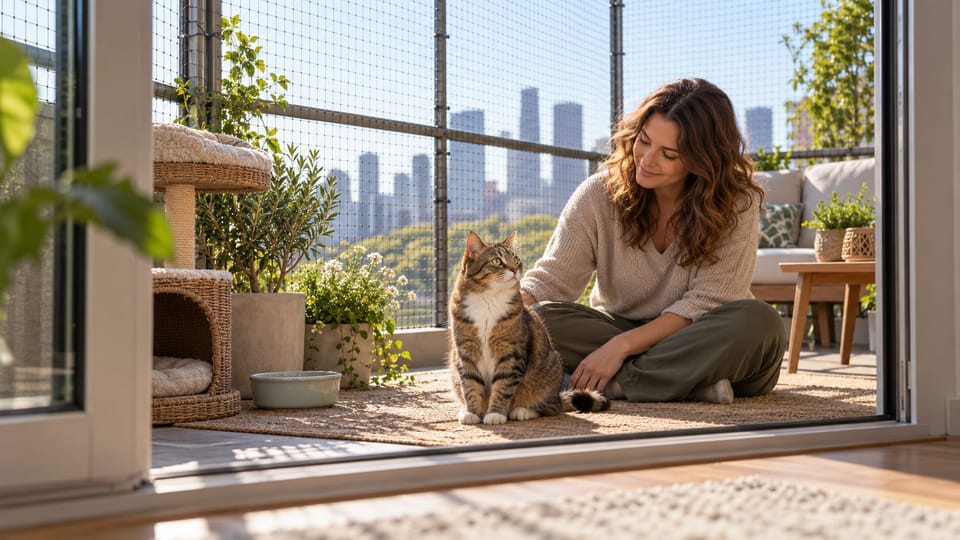
Can I leave my cat on the balcony? Not alone, and not for any length of time a veterinary source will call safe. We found no vet or animal welfare body that gives a "safe" number of unsupervised minutes, because the two main risks do not work on a timer. Falls are accidents that happen in a moment of distraction, and heat builds as the sun and shade move. The honest limit is simple: your cat is on the balcony only when you are out there too, with shade, water and an open way back inside.
If your cat has fallen, or is panting, drooling, weak or collapsed after time in the heat, move her somewhere cool and call a vet or emergency clinic now. Do not wait to see if she recovers. The ASPCA says a fallen cat should be "immediately located and taken to the nearest animal hospital or family veterinarian," and it lists collapse and seizures among the signs of heat stroke.
This is general information, not veterinary advice. Your vet is the right person for questions about your own cat, especially if she is older, flat-faced or has a heart or lung condition.
Can I leave my cat on the balcony if I stay close by?
"Close by" needs a definition, because it is where most balcony plans quietly fail.
Being in the next room with the balcony door open is not supervision. You cannot see the railing, you cannot react, and a cat can go from the floor to the top rail faster than you can get up from a sofa. In a PetMD article on balcony safety (published April 23, 2018, read September 25, 2026), the veterinarians quoted stress "the importance of supervising your companion while on the balcony. It takes just one moment." Dr. Sonja Olson, a senior emergency clinician at BluePearl Veterinary Partners, adds that cats are "more prone to jumping onto and over" balcony railings than squeezing through them.
So supervision means you are on the balcony, awake, watching, and not on a call. When you go inside, your cat goes inside and the door closes.
Why there is no safe number of minutes
People ask "how long is too long?" because it feels like the risk should grow slowly. For falls, it does not.
The ASPCA explains that cats do not deliberately jump from dangerous heights. Most fall by accident, often after focusing on a bird or other animal and losing their balance on a ledge. That moment can come in the first minute or the fortieth. A cat that has sat calmly on your balcony every day for a year has not proved the balcony is safe; she has only not yet seen the wrong bird at the wrong moment.
The Vet Times reported on August 12, 2025 that Alexandra Dontu, head vet at Vets for Pets Sheffield Drakehouse, warned after a cat fell from a fifth-floor balcony during hot weather that "even small gaps or the thin ledge of a balcony railing can be dangerous." Her advice was blunt: "If you're unsure, speak to your vet."
That is why this article does not give you a number. Any number would suggest that the first part of it is safe.
Heat: what a balcony does to a cat in summer
A balcony is often the hottest place in an apartment. It can take direct sun for hours, the walls and floor hold heat, and there may be nowhere to hide.
The ASPCA's hot weather safety tips, read on September 25, 2026, set out the basics: give pets "plenty of fresh, clean water," make sure they "have a shady place to get out of the sun," and "keep them indoors when it's extremely hot." The same page says flat-faced animals such as Persian cats are at greater risk because "they cannot pant as effectively," and that senior pets, overweight pets and those with heart or lung conditions are also more vulnerable.
Heat stroke signs to know before you go out
The ASPCA lists signs of heat stroke that include excessive panting or difficulty breathing, increased heart and respiratory rate, drooling, mild weakness, stupor or even collapse. It also lists seizures, bloody diarrhea and vomiting, along with a body temperature over 104 degrees. We are not listing these so you can watch and wait. If you see them, bring your cat into the cool and call a vet immediately. Only a vet can tell you how serious it is.
Shade moves: plan for the afternoon, not the moment
The shady corner at 10 a.m. may be in full sun by 2 p.m. This is the practical detail most "is it safe?" answers skip, and it is why a balcony that feels fine when you step out can become a problem while you are distracted.
Before you bring your cat out on a warm day, check three things:
| Check | What you are looking for |
|---|---|
| Where the shade will be in an hour | Whether the shaded spot will still exist, not just whether it exists now |
| The floor, with the back of your hand | Tiles, metal and dark decking in direct sun can get hot to the touch; if it is uncomfortable for your hand, it is no place for paws |
| The way back inside | The door open, the path clear, so your cat can retreat into the cool on her own |
And bring water out with you, in a bowl that sits in the shade.
Exposure beyond heat
Heat is the headline risk in summer, but a balcony exposes a cat to other things that change the fall risk too.
- Birds and insects. The very things that make a balcony interesting are the distraction the ASPCA links to falls.
- Sudden noise. Traffic, a neighbor's door or construction can startle a cat near the railing.
- Wind and rain. A cat seeking shelter may squeeze into corners or climb onto furniture near the rail.
- Cold. In winter, a balcony can be colder and windier than the street. The same rule applies: time outside is short, supervised and ends when you go in.
If your balcony's gaps or railing are a worry in their own right, measure them before anything else, and speak to your landlord before attaching any mesh or netting.
A balcony routine that respects the limit
If you want to share the balcony with your cat, a routine keeps the rule from slipping.
- Go out together, come in together. The balcony door closes behind you both.
- Move furniture away from the railing. PetMD's article advises this so pets cannot use it to jump over.
- Shade and water first. Set them up before your cat comes out.
- Skip the hottest part of the day. On very hot days, follow the ASPCA and keep her indoors.
- Consider a harness you hold. The PetMD article suggests a harness or leash on the balcony. The point is that you hold it; never tie a cat to a railing or furniture, where a slip could leave her hanging over the edge.
- Watch, do not multitask. If you need to take a call or cook, bring her inside first.
What about dogs?
The same logic applies to a small dog, with two additions. The ASPCA warns not to let dogs linger on hot asphalt because "sensitive paw pads can burn," and a sun-baked balcony floor raises the same question. And dogs are often on the balcony for a reason: if that is where your potty setup lives, our guide to balcony dog potty systems and where the drainage goes covers the setup, and our plan for an apartment too hot for a dog with no AC covers keeping a dog cool indoors instead. For the broader question of time alone, see how long a dog can be left alone in an apartment. A balcony is not a place to leave a dog while you are out, for the same reasons as a cat.
The honest limit
Here is the answer in one place:
- There is no veterinary-backed "safe" time for a cat alone on a balcony.
- Falls happen in a moment, even to calm cats, according to the ASPCA.
- Heat builds as shade moves, and flat-faced, older, overweight or unwell cats are at greater risk.
- Supervision means you are out there, watching, and it ends when you go inside.
Your cat can enjoy the balcony. She just enjoys it with you.
FAQ
How long can I leave my cat on the balcony?
We found no veterinary source that gives a safe unsupervised time. Falls are accidental and can happen at any moment, according to the ASPCA, so the only safe amount of unsupervised balcony time is none.
Can I leave my cat on a netted or enclosed balcony alone?
A well-fitted enclosure reduces fall risk while you are there, but it does not remove heat risk and it can loosen or fail. Supervision is still the safe default, and your vet can advise on your own cat.
Is it OK to leave the balcony door open while I am inside?
Only if you are actually watching. If you cannot see your cat and the railing, close the door. PetMD's vets note it "takes just one moment."
What temperature is too hot for my cat on the balcony?
We did not find a veterinary source that sets a single cut-off temperature for cats on balconies. The ASPCA advises keeping pets indoors when it is extremely hot and warns that flat-faced breeds such as Persians, seniors and overweight cats are at greater risk. Ask your vet about your own cat.
Should I put my cat on a leash on the balcony?
PetMD's article suggests a harness or leash on the balcony. If you use one, hold it yourself. Never tie a cat to a railing or furniture.
Comments ()