
Cat Pushed Through Window Screen? Why Screens Fail
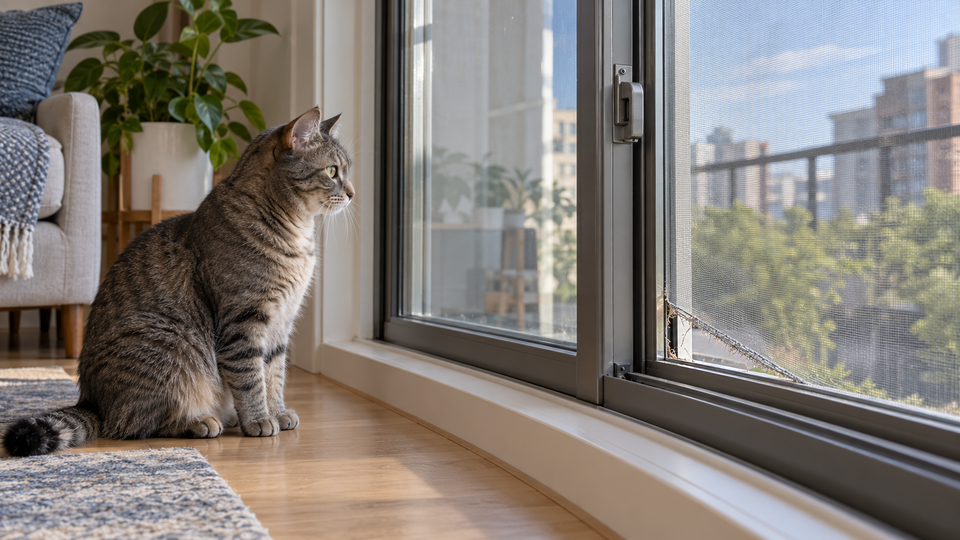
A cat pushed through a window screen is not bad luck with one faulty screen. It happens because a window screen is made to keep insects out, not to hold a cat in. Screens pop out of their frames, and the mesh tears or pulls loose. The US Consumer Product Safety Commission tells parents to "never depend on screens" to stop a child falling, and the same logic applies to a cat lunging at a bird. A screen is not a barrier. A closed window, or one opened only from the top where your cat cannot reach, is.
If your cat has just gone through a screen and fallen, get to a vet now, ideally an emergency hospital. Dr. Stephanie Austin, DVM, writing for Preventive Vet, says to "take them immediately to a veterinary hospital, ideally an emergency facility" and to "never assume that they're not injured, even if you don't see any obvious issues." She also notes there is no at-home treatment, and warns against giving human medications. Call ahead if you can.
This is general information, not veterinary advice. Your vet is the right person for any question about your own cat.
Why a cat pushed through a window screen is so common
The screen's job is insects. Nothing about a standard screen is rated to hold weight or resist a push, and the people who study falls say so plainly.
The US Consumer Product Safety Commission's National Window Safety Week release, dated April 7, 2026 and read on September 25, 2026, repeats its long-standing rule: "Never depend on screens to keep children from falling out of windows." The CPSC's advice is written for children. We are borrowing its logic, not its numbers, because the physics of a screen does not change when the animal leaning on it has fur.
Veterinary sources describe the same problem from the cat's side. The ASPCA explains that most high-rise falls are accidental: a cat focuses on a bird or other animal and loses its balance on a ledge. Put that moment of focus against a screen held in by a few tabs, and the screen loses.
The three ways a screen fails
Knowing how a screen fails tells you what to check. There are three common failure points.
1. The whole frame pops out
Most screens sit in the window opening held by small tabs, springs or friction. In an article on preventing cats from falling out of windows (updated August 20, 2024, read September 25, 2026), Dr. Austin warns: "Some screens might pop out easier than you think." A cat does not need to tear anything if the frame simply leaves the window.
2. The mesh tears or pulls away
The same article notes that "screen material can easily start to pull away from the frame or even rot over time." Sun, age and claws all weaken mesh. A screen that looks fine from across the room may have a loose edge a cat can work open.
3. The screen only covers part of the opening
Some windows have a half screen or a sliding screen. If the screen is on the bottom and the cat can reach the top, or the screen has shifted to one side, there may be an open gap no screen covers at all.
Check your screens from inside, without testing them
You do not need to push on a screen to learn whether it is weak, and on an upper floor you should not lean into an open window to find out. Look instead.
- How is it held? Look for the tabs, clips or springs that keep the frame in place. Missing, bent or cracked ones are your first warning.
- Is it snug? The ASPCA's advice is to "install snug and sturdy screens in all your windows," and if you have adjustable screens, to make sure "they are tightly wedged into window frames." Any visible gap around the frame is a problem.
- Is the mesh intact? Check corners and edges for loose spline, small tears and sun-brittle patches.
- What can your cat reach? Look at furniture, cat trees and shelves near the window. Anything that puts your cat level with the screen makes a lunge easier.
If you find damage, the screen is almost certainly the landlord's property. Report it in writing and ask for a repair or replacement. Stronger pet-grade screening exists, but swapping screens or adding hardware to a window frame is usually a lease question. Our explainer on what counts as a modification in a lease covers how alteration clauses tend to read, and our guide on how to ask a landlord to install a pet device shows how to put the request in writing.
Safer ways to get air with a cat in the apartment
The honest answer is that the safest window is a closed one when your cat is unsupervised. When you do want air, these approaches come from named sources.
| Approach | Source | What to know |
|---|---|---|
| Open from the top, not the bottom | Preventive Vet ("only open the top portion of your windows rather than the bottom"); CPSC gives the same advice for children | Only works on windows where the top sash opens and your cat cannot climb to it |
| Close windows before you leave | Preventive Vet | Also close them before loud noises, such as vacuuming, that can startle a cat |
| Keep furniture away from windows | CPSC, for children | Removes the launch point a cat uses to reach the screen |
| A guard in front of the window | Preventive Vet, with gaps too small for a cat to slip through | Needs landlord permission, and must not block a window you need as a fire exit |
Two cautions sit under that table.
Child window guards are not cat guards. The CPSC suggests window stops that let windows open "no more than four inches," and guards for children. The ASPCA is blunt about relying on child hardware for pets: "Do not rely on childproof window guards to protect your pets! Cats can slip through them." A device built to child dimensions has not been shown to stop a cat.
Do not trade a fall risk for a fire risk. The CPSC says that for windows on the sixth floor and below, window guards should be ones "that adults and older children can open easily in case of fire." If a window is an escape route in your unit, anything you or your landlord put on it has to leave it usable in an emergency. That is a question for your building's management and your local fire rules, not something to improvise.
Hot days are when screens get tested
Windows stay open longest in warm weather, so that is when a weak screen is most likely to meet a cat that has spotted something outside. If your apartment runs hot and you rely on open windows to cool it, plan for the cat first. Our guide to an apartment that is too hot for a pet with no AC covers cooling a unit you cannot modify, and the same thinking applies to cats. Cool the room with the window closed or opened only at the top, and keep the cat out of rooms where a window has to stay wide open.
The honest limit
A screen is not safety equipment. No screen, standard or pet-grade, makes an open window safe for an unsupervised cat, and no veterinary source we read claims otherwise. What reduces the risk is a closed window, a top-opening window your cat cannot reach, and a landlord-approved barrier that still lets you get out in a fire.
FAQ
Can a cat really push through a window screen?
Yes. Screens are built to keep insects out, not to hold weight. Preventive Vet's Dr. Stephanie Austin warns that some screens "might pop out easier than you think," and that the mesh can pull away from the frame or rot over time.
What should I do if my cat fell out of a window?
Go to a veterinary hospital immediately, ideally an emergency facility, even if your cat seems fine. Preventive Vet advises never assuming a fallen cat is uninjured and says there is no at-home treatment. Do not give any human medication.
Are pet-proof screens safe enough to leave a window open?
Stronger screening reduces some risk, but it is still held in the same window frame by the same kind of fittings. No source we read says any screen makes an open window safe for an unsupervised cat. Close windows before you leave.
Do child window guards keep cats in?
Not reliably. The ASPCA says: "Do not rely on childproof window guards to protect your pets! Cats can slip through them." Child guards are sized for children.
Can I replace my apartment's window screens myself?
Screens usually belong to the landlord, and changing them or adding hardware may count as an alteration under your lease. Report damage in writing and ask your landlord for a repair or an approved upgrade.
Comments ()