
Two Way Audio Pet Camera: Does It Help Your Pet?
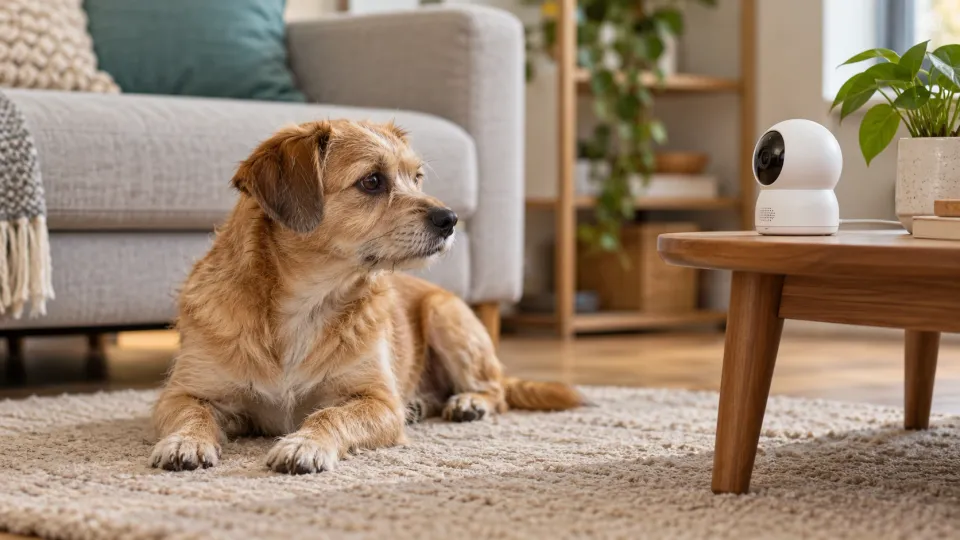
Two way audio pet camera: does it help? Sometimes, and less reliably than the box suggests. The research we could find is on dogs, and none of it tested live talk-back through a pet camera directly. What it does show points two ways. Dogs respond less reliably to speech played through devices than to a person in the room, and a 2022 study found that a recorded voice gave dogs no apparent welfare benefit during a short separation. Whether your voice settles your animal or sends it searching for you is something to test carefully at home, not something to assume.
One thing first. If your dog is distressed when left alone, a camera speaker is not the treatment. The ASPCA's page on separation anxiety (read September 24, 2026) asks owners to see their dog's veterinarian "to rule out medical issues" before any behavior work, and points them to a Certified Applied Animal Behaviorist (CAAB) or a board-certified veterinary behaviorist (Dip ACVB). This article covers the device question only.
What your voice sounds like through a camera speaker
A camera speaker is small, and the sound it plays has been compressed, sent over the internet and played back through hardware designed for people. That matters more than it might seem.
A 2025 study by Higaki and colleagues at Eötvös Loránd University in Budapest, published in Scientific Reports (read September 24, 2026), tested how dogs responded to trained verbal cues delivered in different ways: soundboard buttons, loudspeakers and a person speaking directly. The authors report that "dogs' responses to verbal cues were significantly affected by the device type," with the "best performance observed for direct human speech and the lowest performance for AIC buttons." They conclude that the "level of sound degradation significantly affects dogs' recognition of recorded speech."
The same paper explains part of why. Dogs hear frequencies between 65 Hz and 45,000 Hz, while "playback equipment is almost exclusively optimized for human auditory perception, with frequency responses typically designed to capture sounds up to 20 kHz."
To be clear about the limits: that study did not test pet cameras. It tested cue recognition, not comfort. But it is a direct caution against assuming that your voice through a small speaker lands on your dog the way your voice in the room does.
Voice without the person: what the separation studies found
The second question is whether a human voice helps a dog cope while the owner is out. Here the most relevant work we found is a 2022 study by Rachael Kinnaird and Deborah Wells of Queen's University Belfast, published in Applied Animal Behaviour Science (volume 254; read September 24, 2026 via the university's research portal).
Sixty dogs were separated from their owners and "exposed to the relevant auditory stimulus for 1-hour": classical music, an audiobook, or a control condition. The authors found "only a moderately calming effect of classical music, and no apparent welfare benefits of an audiobook." Dogs in the sound conditions spent more time looking at the speaker, and the authors' overall reading was that auditory stimulation had "little value to dogs in situations of short-term acute stress."
There is an important caveat. The audiobook was a recorded reading, not the owner's voice and not live. So the study does not settle the talk-back question. What it does suggest is that "a voice is playing" and "the dog feels better" are not the same thing, and that dogs may attend to the speaker itself.
Two way audio pet camera: does it help, according to the research?
Put the two findings together and the honest answer looks like this:
- Recognition is not guaranteed. Device audio is a degraded version of your voice, and dogs in the 2025 study responded less reliably to device speech than to a person.
- A voice is not comfort by default. In the 2022 study, a recorded human voice gave dogs no apparent welfare benefit during a short separation.
- The live owner's voice is untested. We did not find a published study of owners talking to their own dogs through pet cameras. Anyone who tells you it calms dogs, or that it harms them, is going beyond the evidence we could find.
That leaves three realistic outcomes for any one animal: your voice settles it, it ignores the speaker, or it hears you and starts looking for you. The third is the one owners worry about, and it is the one to test for.
The apartment layer: one room, one door, one shared wall
In a house, a dog that hears its owner and goes looking has several rooms to search. In a studio or one-bedroom, the search usually ends in one place: the front door. Before you rely on talk-back, check whether your camera can even see that door, because that is where a searching dog is likely to end up.
There is a neighbor question too. If your voice sets off barking or howling, that sound goes straight through the shared wall. A feature you used to comfort your dog can become the reason for a noise complaint, especially if you tend to check in during the evening or late at night.
And there is the speaker volume. A camera turned up loud enough to be heard across the apartment is also loud enough to be heard by the animal at close range. Start low.
How to test it without making things worse
Run the test while you are at home, so you can step in if it goes badly.
- Set up in another room. Sit where your animal cannot see or smell you easily, and open the camera app.
- Pick a calm moment. Speak only when your animal is settled, not when it is barking or whining. The ASPCA's advice for real arrivals is to "say hello to your dog and then don't pay any more attention to him until he's calm and relaxed." Reserving your voice for calm moments applies the same logic to the speaker.
- Say one short, ordinary phrase, then stop. Use a normal tone at low volume.
- Watch for two minutes. Does your animal glance at the speaker and settle, ignore it, or get up and start moving toward the door or around the room?
- Repeat on a different day before drawing a conclusion. One reaction is not a pattern.
Two things not to do. Do not use the speaker to startle or scold an animal for barking or chewing. The ASPCA warns that for anxious dogs, "If you punish him, he may become even more upset and the problem could get much worse." And do not keep talking to a dog that is getting more agitated in the hope that it will settle eventually.
Signs the voice is winding your animal up
Stop using the talk-back feature and speak to your vet if you see any of these after your voice plays:
| What you see on the feed | What to do |
|---|---|
| Searching: moving from room to room, going to the door | Stop talking and note the time; retest at home later, or drop the feature |
| Barking, howling or whining that starts or gets worse | Stop talking; do not reply to the noise |
| Pacing in a fixed or circular pattern | Stop; the ASPCA lists pacing among signs of separation anxiety |
| Scratching or chewing at the door | Stop; the ASPCA lists escape attempts among those signs too |
| Heavy panting or drooling when it is not hot | Stop, and raise it with your vet |
The ASPCA's page also names "heavy panting, excessive salivation, frantic escape attempts, persistent howling or barking" as signs of distress. If any of those follow your voice, the feature is not helping this animal, whatever it does for someone else's.
Cats and other animals
Everything above is dog research. Cats, rabbits, birds and other animals are not small dogs, and their responses to a disembodied voice may be quite different. We did not find studies we could rely on for camera talk-back with other species. If you want to try it, use the same test: at home, at low volume, in a calm moment, and stop at the first sign of searching, hiding or agitation. Your vet is the right person to ask about your particular animal.
When the camera should stay silent
Some situations call for using the camera as eyes only:
- the animal is new to your home and still settling,
- the animal has shown any distress when left alone,
- the test above produced searching, pacing or barking,
- it is late at night and the building is quiet.
Watching without talking still has value. Clips of how your animal behaves when alone can help you describe the behavior to your vet or a behaviorist, and they do not risk teaching your animal that the speaker means you are nearby but out of reach.
Frequently asked questions
Does talking to my dog through a camera calm them down?
It depends on the dog, and the published evidence is thin. A 2022 study found no apparent welfare benefit from a recorded human voice during a short separation, and a 2025 study found dogs respond less reliably to speech from devices than from a person. Test it at home first.
Can my dog recognize my voice through the camera speaker?
Possibly, but not as reliably as in person. The 2025 Eötvös Loránd University study found device type significantly affected how dogs responded to verbal cues, and that sound degradation affects recognition of recorded speech. A small camera speaker is a degraded channel.
Is two-way audio bad for a dog with separation anxiety?
A camera is not a treatment for separation anxiety. Before anything else, the ASPCA asks owners to see their veterinarian to rule out medical issues, then work with a CAAB or Dip ACVB. Ask them whether talk-back fits the plan.
Should I use the speaker to stop my dog barking?
Using your voice to scold through a speaker risks the kind of punishment the ASPCA warns can make anxious dogs "even more upset." If barking is a problem, especially in an apartment with shared walls, talk to your vet or a qualified behaviorist about the cause.
Comments ()