
Window Film for a Dog That Barks at the Window
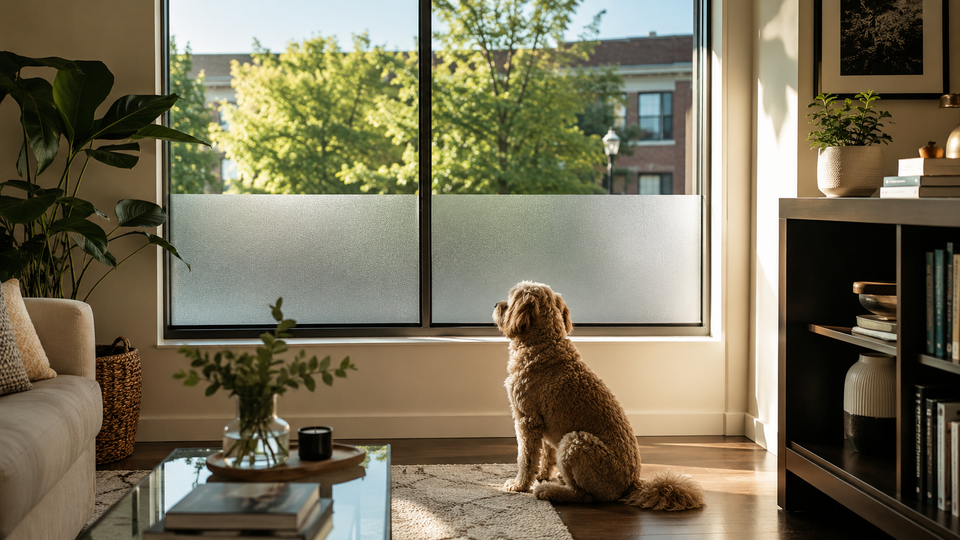
If your dog barks at people, dogs or cars going past, blocking the view usually reduces it, and frosted film is the renter's version of doing that without losing daylight. The method that matters: measure to the dog's eye level standing and sitting, and cover the glass from the sill up to that line rather than the whole pane. For a tenant there is one more decision the installer sites skip entirely, which is static cling versus adhesive, and it is the one that decides whether the film is an issue at move-out.
Take a trigger inventory of the whole unit
Treating one window and leaving another is the most common reason this fix underperforms. A dog with a route around the apartment will simply move to the next sightline.
Walk the unit and list every piece of glass at animal height:
- The main window or windows in the room the dog spends the day in
- A glazed balcony or patio door, which is usually full height and the strongest trigger in the apartment
- Any glass panel beside or in the front door
- A low windowsill the dog or cat uses as a perch, which raises effective eye level well above standing height
- Gaps a blind or curtain leaves at the edges, which a dog will learn to use
Then decide which of those the dog actually uses. Watching for a day is more useful than guessing, because the barking usually clusters at one or two positions rather than spreading evenly.
Measuring to eye level, and keeping the daylight
Film does not have to cover the whole pane, and covering the whole pane is what makes a small apartment feel like a basement.

Measure the height of the dog's eyes when standing, then again when sitting or lying in its usual spot, and take the higher of the two. Add a margin for a dog that stretches up. Cover from the sill to that line. Everything above it stays clear glass, so the room keeps its light while the dog loses its view of the sidewalk.
The one adjustment: if the dog uses a raised perch, a sofa back or a windowsill, effective eye level is the perch height plus the dog's own, and the coverage line has to rise accordingly, or the perch has to move.
Frosted and patterned films diffuse light rather than blocking it, so daylight through the treated section is reduced but not eliminated.
Static cling versus adhesive: the renter's actual decision
| Static cling film | Adhesive film | |
|---|---|---|
| How it attaches | Static and surface tension against clean glass | A permanent or semi-permanent adhesive layer |
| Removal | Peels off, generally without residue | Can require scraping, heat or solvent depending on age and product |
| Reusable | Often yes, if stored flat | Usually no |
| Risk at move-out | Very low | Residue on glass, and disputes over older or single-pane windows |
| Durability | Can lift at edges over time, especially with humidity or a curious pet | Stays put |
| Best for | Renters, short tenancies, testing whether the fix works at all | Long tenancies where the landlord has agreed in writing |
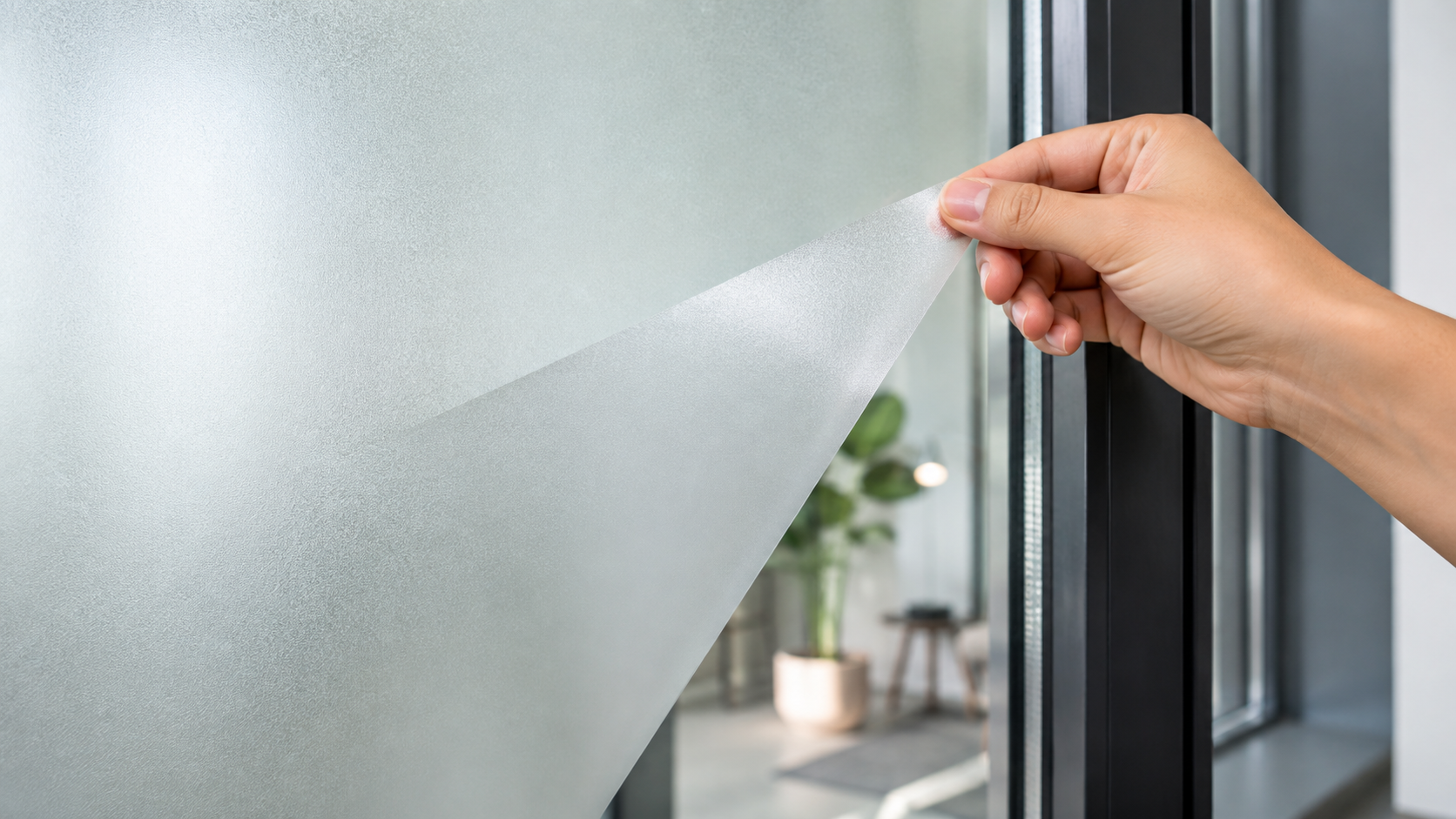
For a tenant, static cling is the default first move. It costs less to be wrong, it comes off, and it answers the only question that matters at this stage, which is whether removing the view actually changes this particular dog's behavior.
One caution specific to pets: a dog that paws or scratches at the glass can lift a cling film at the edge, so check the bottom edge periodically rather than assuming it stays put.
Where this sits among the other renter-safe options, and how attachment method drives deposit risk generally, is covered in renter-safe soundproofing that comes off at move-out.
Where film beats curtains, and where it does not
Film and heavy curtains are often treated as the same fix. They are not.
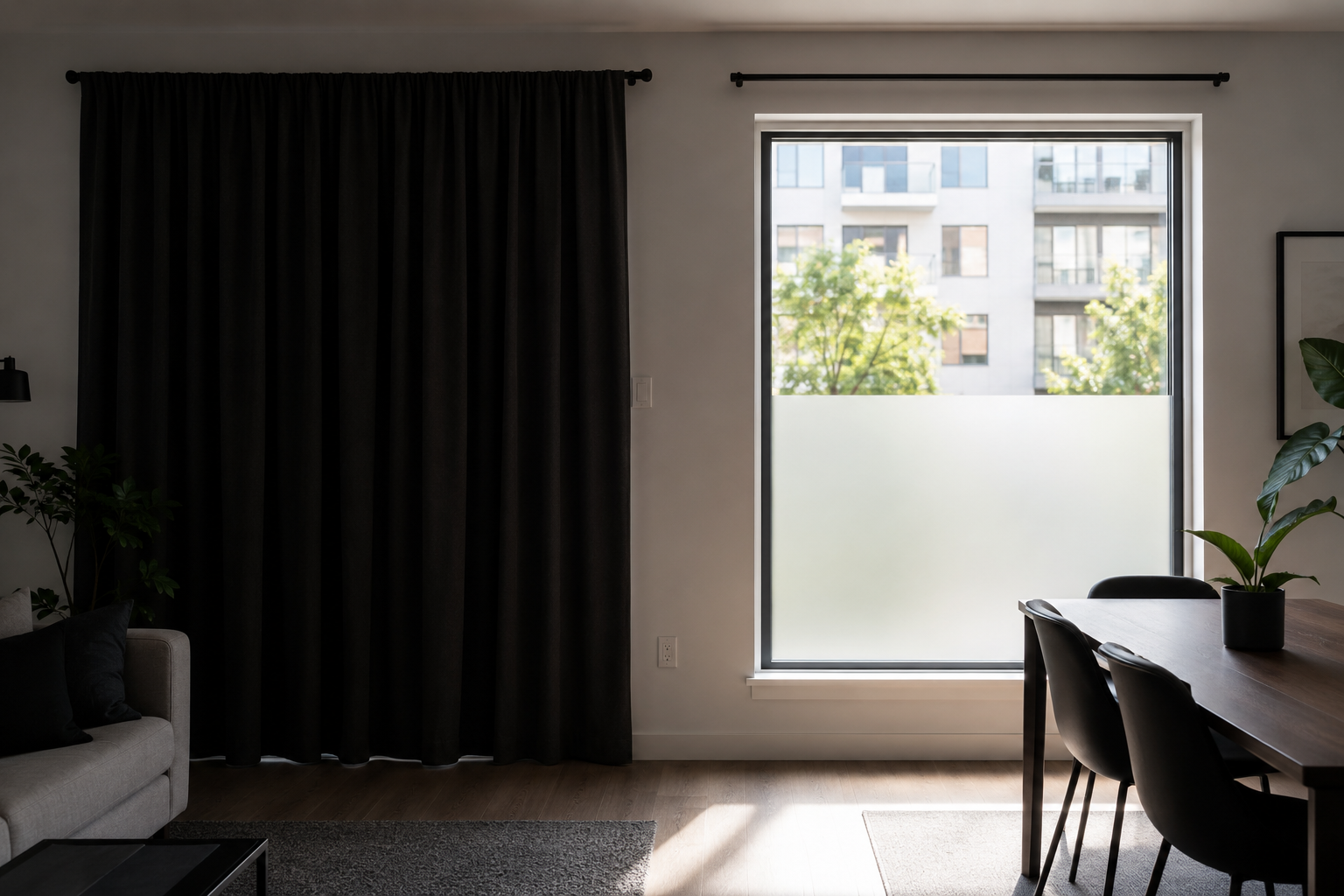
Film wins on daylight. A closed curtain blocks the view and the light together, which is a real cost in a small apartment where one window may be the only source. Film keeps the upper pane clear.
Film wins on consistency. A curtain works only when it is closed, and the day it gets left open is the day the barking returns. Film is always in place, which matters most when the dog is alone.
Curtains win on sound. Fabric has mass and film has essentially none, so if barking is escaping outward through the glass and reaching the street, film does nothing about it. That is the acoustic side of the same window, covered in heavy curtains and window inserts for barking that escapes outward.
Many apartments end up wanting both, for different reasons and at different times of day.
What removing the view does not do
It removes one channel. The dog can still hear the corridor, the street and the neighbors, and a dog that is reacting mainly to sound will keep reacting. The sound side of trigger removal is covered in white noise machines: masking the trigger vs masking the bark.
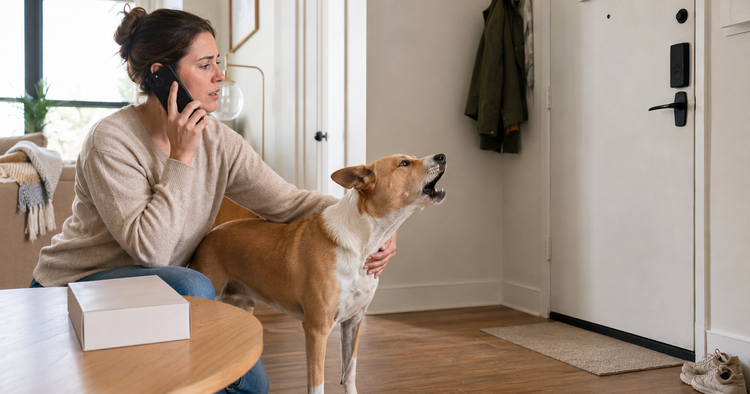
More importantly, blocking a trigger is not the same as changing how a dog responds to that category of trigger. It reduces how often the dog rehearses the reaction, which is a genuine and useful effect, and it is not training and does not claim to be. Why a dog reacts the way it does, and how to change that, is work for a qualified trainer or a veterinarian, and this site does not attempt to teach it.
If the barking continues at similar intensity with every sightline blocked, that is useful information rather than a failed purchase: it suggests the trigger is not visual, and the next step is when the answer isn't a device: getting a trainer or a vet involved.
FAQ
Does window film actually stop a dog barking at the window? For barking driven by what the dog can see, blocking the view usually reduces how often it happens, because the trigger is no longer arriving. It does not affect barking triggered by sound, and it is not a substitute for addressing why the dog reacts.
How high up the window should the film go? To the dog's eye level, measured standing and sitting, with a margin for stretching up. Covering only up to that line keeps daylight coming through the top of the pane, which matters in a small apartment.
Will window film damage a rental window? Static cling film uses no adhesive and generally peels off cleanly, which is why it is the safer choice for a tenant. Adhesive film can leave residue and can be an argument at move-out, particularly on older glass, so get written agreement before using it.
Can I use film on a balcony door? Yes, and a full-height glazed door is often the strongest trigger in an apartment, so it is frequently the piece of glass worth treating first. Check any building rules about the external appearance of balcony glazing before covering a large area.
My cat sits on the windowsill. Does this apply? The principle is the same, though cats more often watch quietly than vocalize at what they see. If a cat is reacting to something outside, the perch height sets the eye level, and moving the perch is often easier than covering the whole window.
Comments ()