
Does Your Dog Actually Bark All Day? How to Find Out
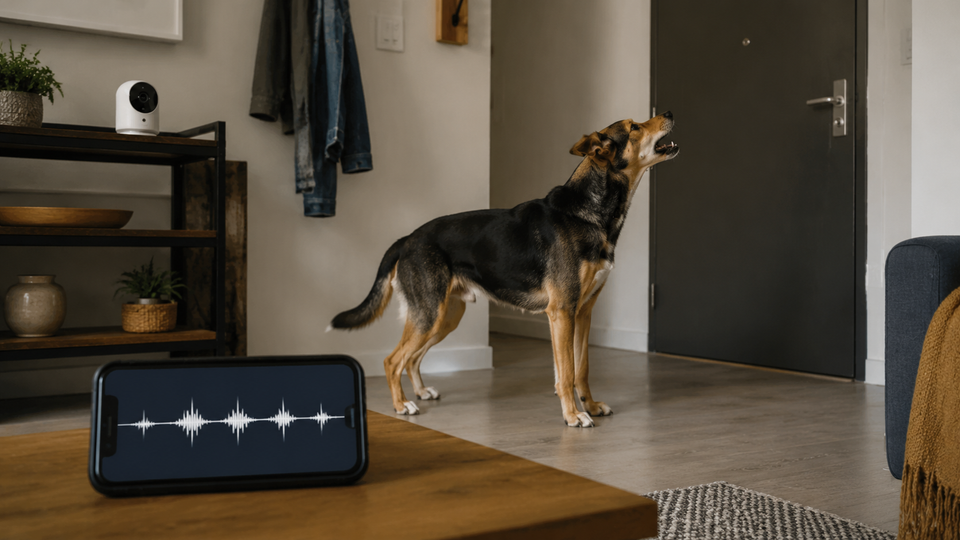
Before spending anything on a fix, find out what is actually happening. Barking that turns out to be eleven minutes at 9 a.m. is a completely different problem from barking that runs for six hours, and almost every wrong purchase in apartment pet noise comes from guessing which one you have. What you need is not reassurance, it is a record: duration per episode, how many episodes, and the clock time of each. That record answers the neighbor, satisfies a building manager, and is the first thing a veterinarian will ask for.
What to actually measure
The instinct is to check whether the dog is okay. The useful thing is to count.
Three fields do almost all the work:
- Duration per episode. How long each stretch of barking lasts, in minutes.
- Episodes per day. Three short bursts is a trigger pattern. Continuous barking is not.
- Clock time. Whether it falls inside quiet hours, and whether it clusters at a particular moment such as ten minutes after you leave.
That is the same shape as the rules that govern the problem. Animal-noise provisions in many municipal codes are written in terms of how long and when rather than how loud, and a landlord building a case generally has to show a pattern that continued over time. So one log serves every conversation you are likely to have. What each of those rulebooks actually requires is in quiet hours and noise ordinances, and why a duration record beats a decibel reading is in phone decibel apps and what they're actually worth.
The four ways to get that data
| Approach | What it produces | Works best when | Watch out for |
|---|---|---|---|
| Dedicated pet camera with bark alerts | Push notifications plus video, usually with an adjustable sensitivity setting | You want to see as well as count | Sensitivity set too high logs the neighbor's dog as yours |
| General security camera with sound detection | Sound events you configure, sometimes filtered to specific sound types | You already own one | Sound-type detection varies by generation and can change |
| Phone-as-monitor app on a spare device | Live audio and an activity log, over WiFi or mobile data | Budget is the constraint and you have an old phone | Ties up a device, and battery or app updates can interrupt a session |
| Wearable tracker that logs bark patterns | A trend over days rather than individual events | You want the shape of a week, not a single day | Gives you a pattern, not the detail a specific complaint needs |
No recommendation is made here on which product to buy. This site does not publish product picks while it has no affiliate disclosure page, and no device on this list has been tested first-hand.
The feature you bought can be taken away
This is the part no vendor page will tell you, and it is worth knowing before you buy on the strength of one feature.
Sound detection is software. It ships, it changes, and sometimes it is removed. One major camera platform's newer generation dropped the dog-barking sound notification that its previous generation had, keeping only smoke and carbon-monoxide alarm detection, a change documented in that manufacturer's own community forum and still in effect when checked in August 2026.
Two practical consequences. Check the current documentation for the exact model and generation, not a review written two years ago about a previous one. And if the bark alert is the whole reason for the purchase, prefer an approach where that capability is the product's core purpose rather than one item on a long feature list, because that is the feature least likely to be quietly retired.
What a monitor does not tell you
A monitor records that barking happened. It does not tell you the dog is fine.
That gap has a name in this cluster: false reassurance. A camera showing a dog lying down between episodes tells you nothing about whether the animal is distressed, in pain, or too warm in a sealed flat. It is a sound and image record, not a welfare assessment.
There is also a failure plan worth having before you rely on one. If the WiFi drops, the app updates, or the device loses power, you get silence, and silence looks identical to a quiet dog. Decide in advance what you will do when you get no notifications for a day, because the natural reading of no news is good news, and here it is not.
If the log shows barking that begins shortly after you leave and continues through the absence rather than tracking passing triggers, that is the pattern worth taking to a professional rather than to a hardware store. Who to approach, and what each can do, is in when the answer isn't a device: getting a trainer or a vet involved.
Turning the log into a neighbor and landlord document
Once you have two weeks of data you hold something most people in this situation never get: facts.
With the neighbor, it converts an argument into a comparison. If your log and their experience disagree, one of you is capturing something the other is not, and that is a solvable conversation rather than a standoff. How to open it is in talking to the neighbor before it becomes a complaint.
With the building, it does something better than defend you: it shows you took the complaint seriously and investigated. Paired with a dated note of what you changed and when, it is close to the strongest response a tenant can give. The full structure of that response is in documenting a noise complaint when it's your pet.
Keep it plain. A dated list of episodes and durations, with what changed and when, in one file.
FAQ
How do I find out if my dog barks when I am not home? Use a sound-triggered camera, a phone-based monitor app on a spare device, or a wearable that logs bark patterns, and record duration, count and clock time for at least a week or two. A single day is not enough to tell a trigger pattern from a continuous one.
Are bark alerts accurate? They depend on a sensitivity setting, and in an apartment they can pick up another dog through a shared wall or activity in a corridor. Check a sample of alerts against the actual recording before treating the count as reliable.
Is a bark counter on a collar as good as a camera? It gives you a pattern over time rather than individual events, which is useful for spotting a change and less useful for answering a specific complaint about a specific evening. What you need depends on whether you are investigating or responding.
Will monitoring tell me if my dog is anxious? No. It records sound and sometimes video. Distress in a dog left alone is assessed by a veterinarian or a veterinary behaviorist who can examine the animal, and a monitor's footage is at most one input to that conversation.
What if the monitoring shows my neighbor was wrong? Then you have something worth sharing, kindly. It is also worth checking whether the sound reaching them is coming from your unit at all, since barking carries along corridors and through structure in ways that make the source hard to place. See pet noise in an apartment: what neighbors actually hear.
Comments ()