
Rugs and Underlay for a Dog That Runs and a Cat That Lands
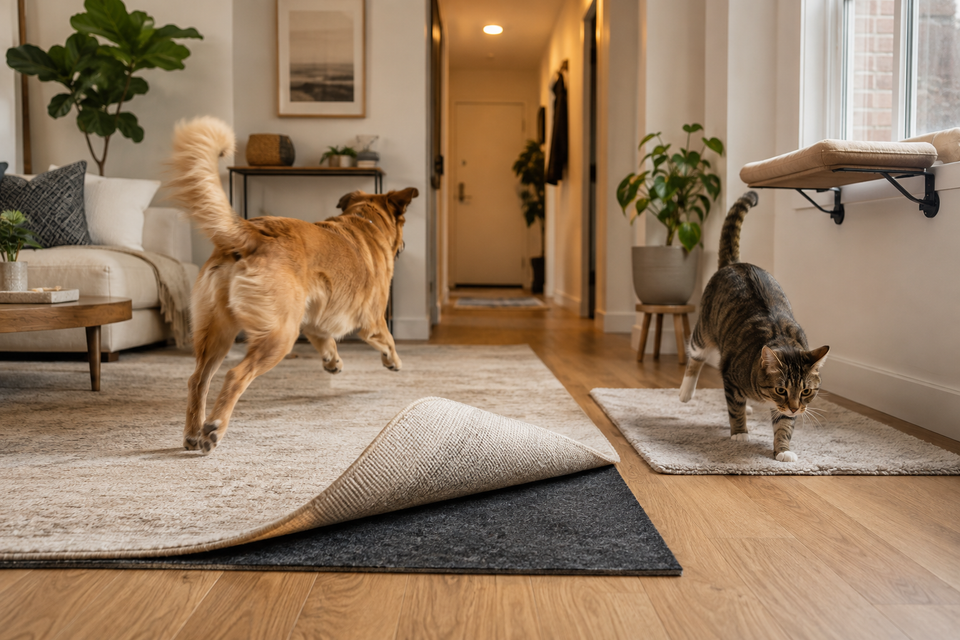
For a downstairs neighbor complaining about a pet, the fix is a dense pad under a rug, and the pad matters more than the rug. Impact noise is vibration entering the floor structure directly, so it has to be absorbed at the point of contact before it reaches the joists. A thick rug on a thin pad does far less than a moderate rug on a dense one. And before buying anything, check the lease: many US metro leases and building house rules already require you to cover a set percentage of hard flooring, which changes this from an expense into a term you agreed to.
Why impact noise ignores everything you did to the walls
Airborne sound, like barking, travels through the air of your room and out through walls, doors and windows. Impact sound skips that step entirely. A paw striking a hard floor, or a cat landing after a jump, puts vibration straight into the floor slab or the joists, and the structure carries it to the ceiling below, where it radiates into your neighbor's room as noise.
That is why a downstairs complaint survives every wall treatment you buy, and why the two problems have to be diagnosed separately. The full explanation of the two paths is in airborne vs impact noise for apartment pets.
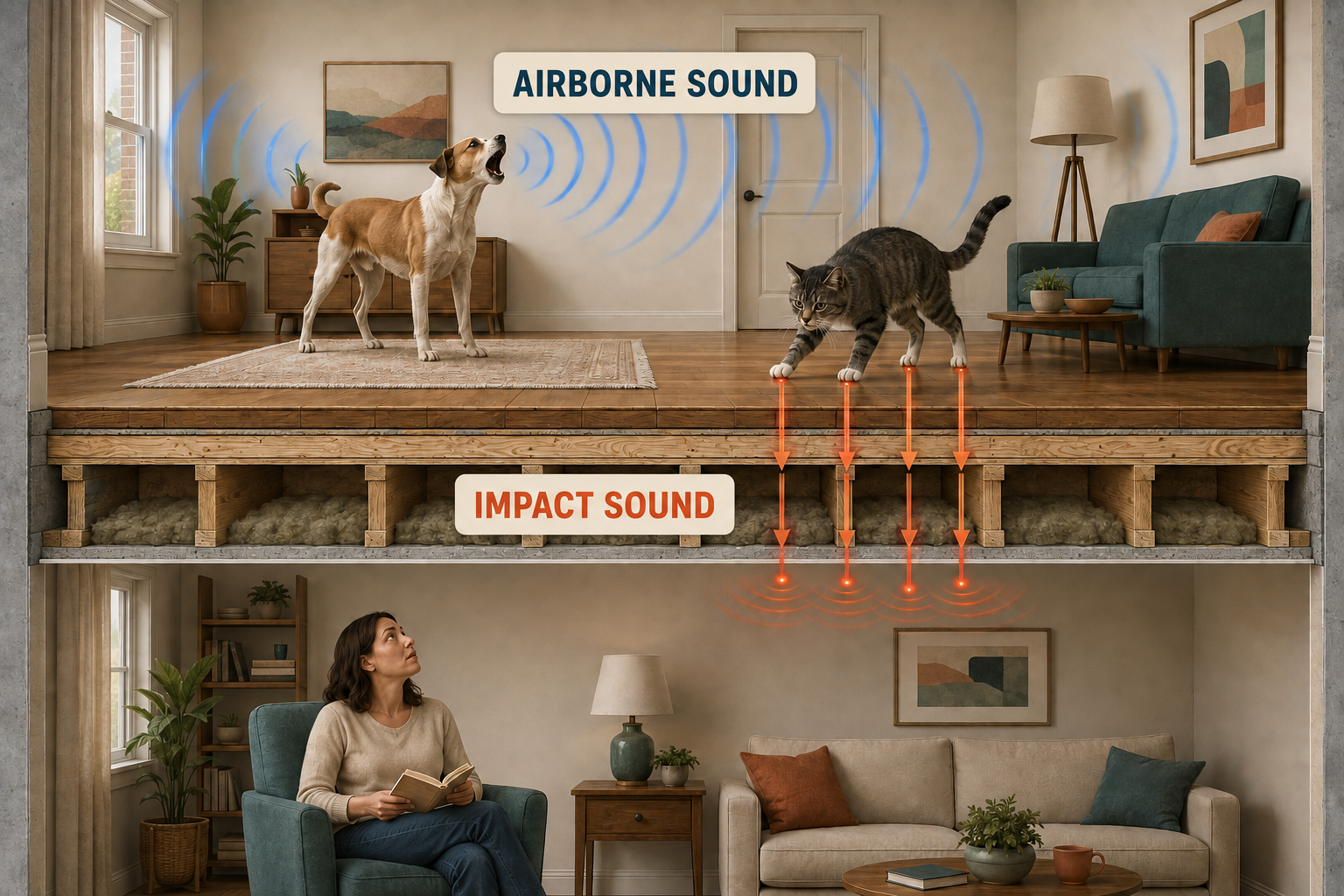
Impact sound is measured with its own test. Under ASTM E492, a standardized tapping machine with five hammers drops repeatedly on a floor assembly, and the transmission below is measured across 16 frequencies between 100 Hz and 3150 Hz to produce an Impact Insulation Class rating.
IIC, STC, and what a renter is actually adding to
| IIC | STC | |
|---|---|---|
| Full name | Impact Insulation Class | Sound Transmission Class |
| What it rates | Impact sound through a floor-ceiling assembly: footfalls, dropped objects, a landing cat | Airborne sound through walls, doors, windows, floors |
| How it is measured | ASTM E492, standardized tapping machine | Laboratory airborne transmission loss |
| Higher number means | More impact sound stopped | More airborne sound stopped |
| Code baseline in US multifamily | The International Building Code sets a minimum of IIC 50 | And a minimum of STC 50 |
The important renter takeaway from that table: the floor assembly's rating was set when the building was built, and you cannot change it. What a rug and pad do is add a soft layer on top of the assembly, absorbing energy before it enters the structure. A good pad can make a real difference to what the unit below hears. It cannot repair a building that was constructed to the minimum and is performing at the minimum.
If your building is genuinely at the floor of the code, the honest position is that you can improve your contribution and you cannot fix the building, and that is worth saying to a neighbor plainly rather than over-promising.
Check the lease first: the 80 percent floor-covering rule
Many leases, co-op house rules and condo bylaws in dense US markets require residents to cover a set share of their floors, commonly 80 percent and in some buildings 85 percent, with kitchens and bathrooms usually excluded. Area rugs typically count toward the requirement.
Three things are worth knowing about this clause:
It is a lease or house rule, not a law. Reporting on it consistently notes there is no state or municipal statute behind the 80 percent figure; it lives in lease provisions and building rules, and it is common in markets including New York, New Jersey, Los Angeles and San Francisco. So the question is never "what does the law say," it is "what does my lease say."
It cuts both ways, and mostly in your favor. If a neighbor has complained and the building has this rule, buying rugs is compliance rather than concession. It is also a concrete, documentable action you can report to a property manager, which changes the tone of the conversation from a dispute about a pet to a record of a resident addressing a floor-covering obligation.
Enforcement is real but usually curable. Where the clause exists, failure to comply can be treated as a lease default, and the standard cure is simply installing the required covering.
This is general information about a common lease term, not legal advice, and wording varies by building. Read your own lease and house rules, and if the requirement is unclear, ask the property manager in writing.
Map the landing zones, not the floor area
Square footage of coverage is the wrong mental model for a pet, because pet impacts are concentrated rather than distributed.
For a dog, the noise is a running path: the route from the sofa to the front door, the hallway it accelerates down, the spot it turns. Walk that route and cover it continuously. A rug that stops halfway leaves the loudest part, the acceleration and the turn, on bare floor.
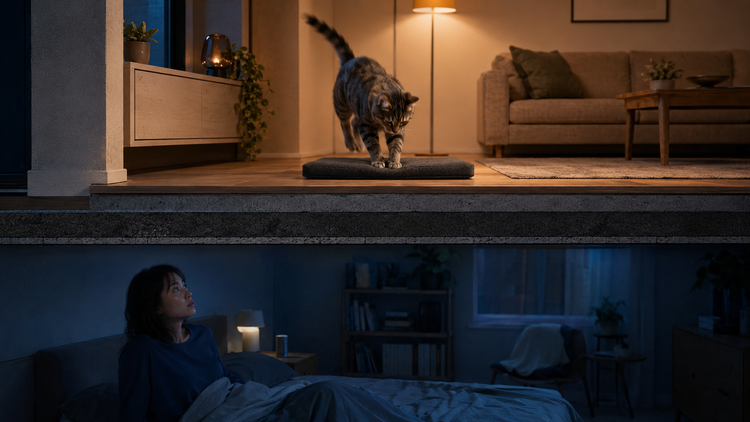
For a cat, the noise is a set of landing points: the floor beneath the counter, the windowsill, the top of a wardrobe, the cat tree. A single landing from height concentrates a lot of energy into one spot, which is why a large rug placed for the room's appearance often misses the actual problem entirely. Cover the floor directly under each place your cat jumps down from. This is also the topic that produces most 4 a.m. complaints, since that is when the activity happens.
Practical implication: two well-placed smaller rugs on dense pads usually outperform one large decorative rug that happens to occupy the middle of the room.
What does not work as well as people expect
A rug with no pad, or a thin foam pad. The rug alone does little for impact transmission, since the hard floor beneath is still what receives the strike. Vendor guidance for acoustic underlay generally points toward thicker, denser material, on the order of half an inch or more, and rubber or dense felt rather than open foam.
Interlocking foam tiles as a whole-floor solution. They are genuinely renter-friendly and they help at the point of impact, but they are soft, light and easily compressed, so they are better thought of as a landing-zone treatment than as an acoustic floor.
Wall treatments of any kind. Worth repeating because it is the most expensive version of this mistake: acoustic panels do nothing for a downstairs neighbor, for the reasons set out in acoustic panels for pet noise. Floor treatment has one quiet advantage over every wall fix, which is that it attaches to nothing: no adhesive, no ratings, no removal technique, no deposit exposure. Everything that does have to be attached is covered in the deposit-safe mounting toolkit.
For where floor treatment sits among the other renter-reversible options, and how each one attaches, see renter-safe soundproofing that comes off at move-out. For the broader picture of what your neighbors actually hear, start at pet noise in an apartment: what neighbors actually hear.
FAQ
Does a rug actually stop my dog's running from being heard downstairs? It reduces it, and the pad underneath is doing most of that work by absorbing the impact before it reaches the floor structure. A rug laid straight onto hardwood helps far less, because the hard surface underneath is still receiving and transmitting the strike.
How thick should the pad be? Acoustic underlay guidance generally points toward denser and thicker material rather than a specific universal number, with half an inch often cited as a reasonable starting point for impact reduction. Density matters as much as thickness, which is why rubber and dense felt are preferred over light open-cell foam.
Is the 80 percent carpet rule an actual law? No. It is a lease clause or building house rule, common in several dense US metro markets, and it is not backed by a state or municipal statute. Whether it applies to you depends entirely on your own lease and your building's rules.
My cat only makes noise at night. Do I need to cover the whole floor? Usually not. Cat noise is concentrated at landing points, so covering the floor directly beneath the surfaces your cat jumps down from typically addresses more of the problem than a larger rug placed elsewhere in the room.
Can I make my building's floor quieter overall? Not as a renter. The floor-ceiling assembly's impact rating was determined by how the building was constructed, and a rug and pad add a layer on top of it rather than changing it. That is a real improvement and a real limit, and both are worth stating honestly to a neighbor.

Comments ()