
Aiming an Ultrasonic Device at a Neighbor's Dog
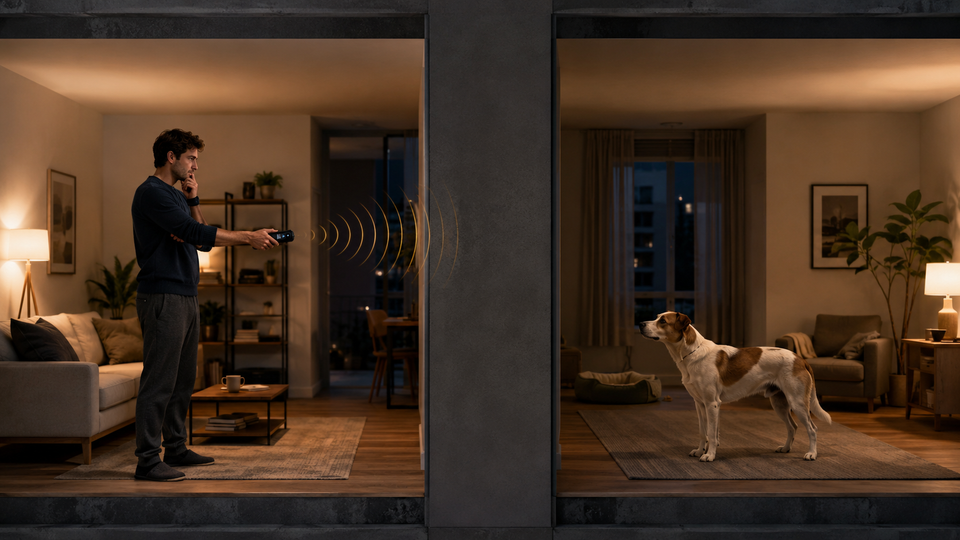
Don't. Not because a statute names the device, since no federal or state law specifically bans consumer ultrasonic bark deterrents, but because aiming one through a shared wall means applying an aversive stimulus to an animal you do not own, cannot see, and cannot assess for harm. That is the welfare problem. The legal exposure is separate and real: attorneys answering this question consistently point to animal cruelty complaints, nuisance, and in some framings trespass, and they consistently note that how the device is used matters far more than the device itself.
This is general information, not legal advice. If you are dealing with a genuinely persistent problem, a local attorney, your building manager or animal control are the right routes.
What the law does and does not say about the device itself
The device is legal to buy and own in the US, and there is no specific federal or state prohibition on consumer ultrasonic bark deterrents as products. That is the part people find first, and it is where most of the reasoning stops.
What the legal answers on this question actually turn on is conduct. Running a device continuously, or running it at times when the dog is not barking, changes the character of what you are doing from deterrence to targeting. Attorneys responding to these questions describe that pattern as the thing that converts a lawful purchase into a defensible complaint against you, and note that a device aimed at another property to provoke or affect animals there is arguably both trespass and abuse.
Local rules also vary, and animal cruelty statutes are state law. There is no single national answer, and any page that gives you one is guessing.
Three ways this becomes your legal problem
Animal cruelty or welfare complaint. State cruelty statutes generally reach conduct that causes an animal unnecessary suffering. Whether a given device meets that bar is fact-specific, and the fact-finding happens after animal control is already involved.
Nuisance. A device emitting into a neighboring property can itself be the nuisance, which is a genuinely awkward reversal when your original complaint was about noise.
Trespass. Where the emission is deliberately directed into another unit or yard, some analyses treat that as a physical intrusion onto another person's property.
Add the practical one: dog owners react strongly on discovering a neighbor has been targeting their animal, and the complaint escalates to animal control or civil court faster than a barking complaint ever would.
The welfare argument is the stronger one
Set the law aside for a moment, because this is the part that should decide it.
When a person uses a deterrent on their own dog, they can watch what happens. They can see whether the animal freezes, cowers, redirects, or ignores it, and they can stop. That feedback loop is the only safeguard a consumer aversive device has, and it is thin even in the best case.
Pointing a device at a neighbor's dog removes the loop entirely. You do not know the animal's age, whether it has hearing loss, whether it has a pain condition, whether it is already anxious, or whether it is confined in a way that means it cannot move away from the sound. An aversive with no observer is exactly the condition under which welfare harm accumulates unnoticed, and any distress it causes appears in someone else's home where you will never see it.
The evidence on whether these devices work at all is separately mixed, and worth reading before assuming there is even an upside to weigh: do ultrasonic bark control devices actually work in an apartment.
If the animal in question is your own and barking is the problem, the route is a veterinarian or a veterinary behaviorist rather than any deterrent, set out in when the answer isn't a device: getting a trainer or a vet involved.
What the search data says about how this ends
Look at who is actually asking about this online. The overwhelming majority of the questions are from the other side: people who have discovered a neighbor pointing a device at their dog and want to know what they can do about it, including at least one describing an animal crying while the device runs even when it is not barking.
Those questions are on legal answer sites. That is the shape of the outcome. Before buying, it is worth knowing that the most common next step in this story is the neighbor consulting a lawyer about you.
What to do instead, in order
The underlying problem is real, and there is a sequence that does not put you on the wrong side of it.
- Document it properly. Dates, clock times, durations, how many episodes. Animal-noise provisions are usually written in duration terms, so this is the record that matches the rule. See phone decibel apps and what they're actually worth.
- Find out which rule actually applies before invoking any of them, because the ordinance, the lease and the house rules are three different things. See quiet hours and noise ordinances: what applies to a barking dog.
- Talk to the neighbor first if it is safe and reasonable to do so. Most people do not know how much carries through a wall.
- Use the building's process. A written complaint to the manager creates a record and puts the lease behind it.
- Treat your own side of the wall. Sealing your door, treating your floor and adding mass where you can reduces what reaches you regardless of what the neighbor does, and none of it requires their cooperation. See renter-safe soundproofing that comes off at move-out.
- Escalate to animal control if the dog appears to be left in distress, because at that point it is a welfare matter and they are the people equipped to assess it.
FAQ
Is it illegal to point an ultrasonic bark device at a neighbor's dog? No US federal or state law specifically bans the devices, but that is not the same as it being safe to do. Legal answers on this question point to potential animal cruelty complaints, nuisance and trespass exposure, and they turn on how the device is used rather than on the device itself.
What if I only run it when the dog is actually barking? That is a better fact pattern than continuous operation, and it does not remove the core problem: you still cannot observe the animal or assess what the stimulus is doing to it. The legal risk is reduced, not eliminated, and the welfare objection stands.
My neighbor is pointing one at my dog. What can I do? Document what you observe, including any change in your dog's behavior, and raise it with your building manager in writing. If your dog appears to be in distress, contact animal control and your veterinarian. A local attorney can advise on nuisance and cruelty remedies in your jurisdiction.
Do these devices even work through a wall? The evidence on their effectiveness is mixed even in ideal conditions, and ultrasonic frequencies do not pass well through building structure. The likelihood of a device achieving its stated purpose through a shared wall is one more reason the risk sits on one side of the ledger.
What about a device aimed into a shared corridor or courtyard? The same conduct questions apply, plus you may be affecting animals and people you never intended to. A device emitting into common areas of a building is also likely to be a matter for the building's rules, so check with management before assuming it is your call.
Comments ()